Tuesday, May 25, 2010

Painting is Hard


So is love.

I once thought about collecting all the club-footed things people said to me when beholding one of my paintings. But I didn’t collect them, and I can’t remember them, except for this one, which particularly stings when you fancy yourself a portrait painter: “Faces are hard . . .”

Painting is agony. A friend who is also a painter called me the other day in a total flap because a client wanted to come over to pick up her painting (my friend leaves her sold paintings on her front porch for pick up). But the client also wanted to – gasp! – meet my friend!


I was confused about the problem. What was it? Turns out there was a mix up. My friend was upset because the client actually liked my friend’s paintings and wanted to talk about them. My friend, however, doesn’t like her paintings. The mix up was my friend confusing how she feels about her work with how someone else feels about her work.

I patiently explained to her that clients are like lovers: you don’t get to dictate what they like or why. If they like you (your work), that’s their business, regardless of how much you loath yourself (or your work, which is the same thing). It’s just one of life's little quirks we can’t control.

I remember having an epiphany a few years ago in my therapist’s office as I wailed about not being able to paint like my idol, Jenny Saville. According to moi, I couldn't get the paint thick enough, or the colours clean enough, and my ideas for subject matter were not as beefy and compelling as Jenny's. Ever patient with my disastrous life problems, my therapist offered this shockingly sensible pearl of wisdom: why you don’t you just be the painter you are?


After a decade of painting on and off (mostly off), I have noticed a pattern. It goes something like this:

Day 1 — I’m a fucking genius! This painting is going to ROCK!!
Day 2 — Damn, the colours are getting muddy and the structure is weakening.
Day 3 — Oh my god, I have painted Mr. Potato Head: the dismantled version.
Day 4 — I hate myself.
Day 5 — I still hate myself. I reach for a large bag of Doritos.
Day 6 — I go back into the studio and pull it (and myself) back from the brink.
Day 7 — No time to rest. There’s so much more to do.
Day 8 — I realize everything can be fixed with more paint. Genius!
Day 9, 10, 11 . . . 20 — This 3-day painting is clearly not a 3-day painting.
Day 21 — There is no such thing as a 3-day painting.
Day 22 — I’ll never make a living at this.
Day 23 — Back at my desk, writing communications copy.


Then there was the time I regaled another painter friend with life-threatening adventures in painting failure. How was I to even contemplate living if I didn’t know what to paint? Or, when I figured out my subject matter, how to paint it? This painter friend should rightfully have his own image and alter in my home. He’s my new guru. A gentle man who didn’t have my opportunities for pursuing a graduate degree in painting, he blossomed from an adequate painter into a stellar painter through a process I should know by now because it's the same process for meditation (which I don’t do) and for running (ditto) and for just about everything else one wishes to learn and master. It’s called practice. After ten years of painting consistently, you are bound to improve. After ten years of whining and complaining instead of painting, you are bound to not improve. The math is simple enough for even a math flunky like me to understand.

But the real gift David gave me that day was this. He said, “Liz, it’s just painting. Where’s the harm?”


Recently, I fell in lerve. Woody Allen invents this word in Annie Hall when "love" cannot adequately describe how he feels. For me, I'm not talking about love. Love requires time + a modicum of sanity. But lerve is the only word I have at my disposal right now to describe this loud, perverse, mind-numbing, soul-cracking volcanic eruption that has cast a cloud of ash so thick over my being that any further travels to the Isle of Sanity have been suspended indefinitely. After so much heartbreak in my past, I thought I would never feel this kind of excitement or this level of connection ever again. It’s ridiculous because a) I don’t really know this person very well, so what I’m most likely experiencing is a massive case of projection and b) my unerring divining rod for the wrong person is quivering so violently I can barely hold it in my death grip.

So, I called my painter friend (who hates her work) and admitted my folly, castigating myself for acting like Liz at Twenty, an age at which I had as much sense as, well, as a twenty-year-old who thinks she’s in love. I expected a sound tongue lashing followed by a smart smack to shock me back into my senses. But that’s not what I got. She said, "It’s amazing, really, that J (her partner) and I argue about the same thing and in the same way after twenty years of being together, and after twenty years of therapy that should have made our arguments at least evolve!" Basically, her message was, who the hell knows what wisdom is. But isn’t it wonderful to be alive?


Added to her wisdom is a little from Charlie Kauffman (one of my favourite screen writers). In the film Adaptation, the protagonist, Charlie, is hiding with his (imaginary) twin brother, Donald, in a Florida swamp. They are being tracked by a murderously in-love Meryl Streep (if you want to know why, see the movie). As the brothers crouch behind a log, waist deep in alligator-infested waters, Charlie, crippled with self-loathing, takes this opportunity to ask Donald, awkward, goofy, and vulnerable, about the time in public school when Donald declared his love to a girl and she laughed at him. Charlie wonders why that never seemed to humiliate Donald. Why didn’t it destroy him? Donald patiently explains to Charlie that his love for the girl was his, i.e. even the girl could not take it away from him. How she felt was her business. How he felt was his. And then he gives the most powerful line of the whole movie: you are what you love, not what loves you.


If that’s true, then you get to love no matter how the person or thing at the other end of your love feels about you, i.e. I get to love painting even when painting hates me (which it does. Often). If the object of your love has no idea you exist, you still get to enjoy your butterflies all the same. Just try to squash them. You can't. So you may as well put away the Tums and accept the jitters.


I have a feeling this tsunami of an infatuation will pass and nothing will come of it. But it has accomplished two much-needed metaphorical smacks. A) It dismantled – misguided-belief-by-misguided-belief – all my carefully designed plans for avoiding heartbreak. And, B) It put my belief system back together like a Mr. Picasso Potato Head, making a mockery of perspective in order to show me that life happens in multiple dimensions at once, and never the way you expect. Our lives unfold more like Escher’s hand drawing itself – in the moment, unpredictably, and with its own terrible beauty.


I feel pretty certain I won't land in a soft spot with this wild-ride of a crush who is so hot he could turn volcanic ash to glass, but at least it has given me a chance to practice love, or lerve. At least I have that. And painting.

Sunday, May 2, 2010

OH. MY. GOD.


I’m so over myself. I SWEAR!

When I received the most courageous emails from fellow sufferers after my last post – tender, generous, honest messages from people who are not only fighting for their own lives in one way or another, but also bravely staying the course, against all odds in some cases – these amazing souls made me realize two things:

1) I’m not alone (which is not some kind of misery-loves-company stance. In fact, I immediately went into Liz-fix-it mode, wantonly dispensing unsolicited e-therapy so as to heal their pain, if I could.)

And . . .

2) Andy would definitely not be impressed with my current state of mind, as one friend pointed out in a much-needed tough-love e-mail (Thanks, P!). It’s true. I know exactly what Andy would think about my wallowing because we were psychically liked (as I am with my younger brother, Justin, and my father, Fred, and my sister-in-law, Dawn.) Andy would have said, “You can’t help me. Get on with your life!”


I feel ashamed that I made some of you worry about me. Unfortunately, I can’t take it back. But since I’m trying to accept myself warts and all these days, all I can do now is say thank you and I’m sorry. No, really, thank you for indulging me in a moment of pure self-pity. And I’m so sorry I took you on a journey that came to an abrupt halt the next day when, for no apparent reason, I was right as rain again. Sometimes all it takes is a piece of really moist chocolate cake, or a chance encounter with a celebrity.


A few weeks ago, I met a guy in the dog park with his beyond-gorgeous Italian greyhound, sporting an equally gorgeous little sweater. The dog, not the man. (Well, also the man.) So, I asked the man where he got the doggie sweater, thinking how great it would look on Shy. The man said he’d look for the card of the woman who makes them and bring it to the park next day. I didn’t see him for a few days, but when I did see him next he said, “I brought that woman’s card with me everyday this week to give to you. I’m not sure I have it today.” But he fished in his pocket gamely and found it! That, however, is not the happy ending to this story.


Ever since then, we’ve seen each other almost daily at the dog park (no, this is not a blossoming romance, girls and boys, so get your heads out of that story or you’ll be disappointed with the punch line). Recently, I asked him what he does with this days and he told me he works in the theatre. Yesterday, I asked for more specifics about his work, so he told me he does some writing and directing. I happen to know exactly one person who works in the theatre, so I did the do-know-know-my-friend-Geoff thing. The gent said yes he did, and that Geoff is a marvelous actor. (Must tell Geoff). That made me feel so connected and, yes, even a little cool (although technically Geoff is more a friend of a friend, I decided that really didn’t matter. Knowing him gave me cachet by proxy.). Then the gent reciprocated by asking what I do. Communications and portrait painting, I told him. To which he responded with his own do-you-know-so-and-so-who-is-also-a-painter thing. But I did not know his painter person. So he asked me my name. “Liz Phillips,” I said, to which he responded, “Oh,” before adding, as if it would not ring any bells, “My name is Daniel MacIvor --”

“OH. MY. GOD!!!!!!!!!! YOU’RE DANIEL MACIVOR???!!!!!”


Yup. I yelled it. Right there on the street. With hipsters on the other side of the street watching me as they sucked back their espressos.


I’m not really a star fucker. But I am impressed by talent. And Daniel MacIvor (because there is no way I can call him Daniel) has talent out the wazoo. How could Daniel MacIvor be casually talking to me in the dog park about dog sweaters and other things so mundane I can’t even remember what they were when he is the creator of Past Perfect, a film I caught on Bravo one night when I was living at my father’s house after returning from a failed relationship in Seattle (and on the heels of my fire in Montreal)? (Synopsis: Past Perfect “intercuts between two days, two years apart. The first: a flight from Vancouver to Halifax, where Charlotte and Cecil, two strangers, meet in seats 3a & 3c and fall in love. The second: a Saturday two years later, where Charlotte and Cecil now a couple, fight, break-up and finally reunite.” Thank you IMDB). What story could have been more perfect for me at that time? None, I tells ya!

Some of you may have no idea who Daniel MacIvor is, and that's OK. Celebrity is in the mind of the beholder. I'm also hoping that making a fool of one's self is also in the mind of the beholder. Not the espresso-chugging beholder beholding me, mind you. Maybe yelling Daniel MacIvor's name made his day. Knowing that he had thought to bring me the dog-sweater-maker's card every day made mine. Imagine, Daniel MacIvor thinking of me as he made his way to the dog park!

So, there it is. My life as a dramedy. While it’s true that most of life’s unfolding is out of our hands (when/how we die, who loves us), we do have an insane amount of control over the rest (when/how I will write an article for publication, or when/how I will make a body of paintings for exhibition, or who I will choose to love) – we can create a great deal of our reality through thoughts and actions. (Yes, folks, the Liz of old is back!) It’s also true that while we don’t always get what we want – kids, partners, clear-cut and satisfying careers – we often do get what we need: a Liz Lemon moment of slipping on a proverbial banana peel to remind you that life’s randomness can also be really effing funny.

Thursday, April 29, 2010

Her Dark Matters


This morning, as Shy lay curled in a tiny, furnacy heap pressed against the side of my head, I dreamed I was in a small overgrown field, probably where a building once stood, and opposite a dingy motel in a crappy little town. In the field with me were a handful of transients, men and women about my age who seemed to be between things. Not homeless, per se, but hanging out, waiting to see what came next. They had long, matted hair and flowing tie-dye shirts, like a lost tribe of Dead Heads. I was not part of their posse, but I was clearly in the field because I was in transit, too: on my way to somewhere but I don’t know where, or from whence I had come.


It was dusk. I was looking towards a car that was pulling up along side the field’s edge. The car’s headlights were in my eyes. Once they shut off, I saw my mother behind the wheel. And behind her, in the back seat, was Andy. I felt a surge of mixed emotions – fury that it was her who had saved him from wherever he had been. (I didn’t think of him as dead; I thought of him as having been somewhere awful, like prison.) I didn't trust her motives for saving him. But whatever they were, the result was that Andy was back! Which brought the other emotion: joy!


Andy looked so young, in his 20’s, and small. My height. But he still had the quiet, commanding presence of an older brother. After we hugged, which he simply took in stride, as if he’d never been gone, he went over to the motel to get a room for the night. For some reason, there was no question of my joining him, so I waited in the field. Soon after, though, he called me on a cell phone to tell me that the previous occupants of the motel room had left a pile of clothes that he thought I would like/need. Being in the filed without a suitcase, I was grateful indeed, and so touched that Andy was aware of my needs after only seeing me for a few minutes.


He brought the clothes back to the field. A pile of pants from the Gap, most of which were classic enough that I liked them, with a few pairs looking out of date but I didn’t care. I was so moved by Andy’s thoughtfulness.


Once back in the field with me, Andy started to rally the troops to build a bonfire from all the scraps of garbage strewn in the tall grass. Most of it was plastic. The pile got quite large, and I said to Andy that it was a bad idea to burn it because the plastic would release toxins into the air and likely draw the attention of the police. Andy didn’t seem bothered by either potential outcome. He somehow indicated to me that it was more important that the people in the field felt empowered to do something for themselves. He was giving them a purpose and a reason to work together. They all seemed really happy to build the fire. I stayed on the periphery of the activity, feeling like an outsider, observing, worrying. While I watched, I felt a profound love for Andy for the way he was taking care of us all but mixed with anger that he was not recognizing the danger he was potentially putting everyone in.


Andy got a young blond man with dreadlocks and a giant smile to light the fire. He seemed like the leader of his group. I could see he felt useful and needed. And then we heard sirens. I was terrified they would take Andy away again. But I was more afraid for my own well being, so I backed away from the bonfire and the group and tried to become inconspicuous in the tall grass. The siren turned out to be an ambulance, and not headed for us. Andy pointed to the fire, which was not as big as we all thought it would get, and looked over to where I was hiding and said, “See, you had no reason to worry.”


But I do worry.


I worry that I am utterly stalled. Stranded, even. Shipwrecked on this slippery rock I call my life. While the waters around me teem with friends who have growing and thriving families, and partners who get their backs, and careers that have become sanctuaries, I feel my little rock submerging under the weight of my loneliness, which I naively thought would have a shelf life. I thought by now I would have a family of my own, a partner with whom I would feel safe and loved, and a career that would reflect my passion and instill in me a sense of profound confidence, of knowing my place in the world.


In my better moments, I understand that I am free. Free to create what I want, where I want, when I want. In my more positive moments, I am the first person to spread the message of love and hope to my friends and family, encouraging them to take risks and follow their bliss. But those moments are growing fewer and farther between.


While I was living in Ottawa the first few months after Andy’s death, I believed that once the crisis had passed, I would be able to do anything. I would paint. I would finish my book. I would write articles for Oprah or some other magazine.


Friends have long chided me for being Ms. Chirpy-go-Happy in my posts, a cheerleader hopped up on psychic wheat grass. Some have been downright angry at my commitment to creating my own joy, especially when they are feeling particularly victimized in their own lives. Well, those friends can now rest easy. Because I’m too tired to bother with my happiness right now. And, despite everything I know and believe about my own power in the world, I feel victimized by the world.


When Andy died, it put my own sadness into perspective. It was a like a frank slap on the face, even making me giddy for a while. The worst had happened, so what couldn’t I face? What couldn’t I do? But when I returned to Toronto three months later, even my new townhouse could not buoy me. The world was my oyster but I just wanted to crawl into my shell.


Andy built his plane in 22 months, so why can't I get a simple article written in a month? I write for everyone else – for websites, for newsletters, for work emails, for everything and everyone but for me. There’s nothing outrageous about my goal to be published in a magazine, but it seems a herculean task to write and submit an article. Instead, I write for my blog, which feels safer. Who cares if no one reads it or likes it? I’ll never have to know . . .


The truth is, I feel sorry for myself. There, I said it. And I know that this, too, is part of the grieving process and will pass. But feeling sorry for myself is not a result of Andy’s death. It has shadowed me my whole life. In the last seven years, I have worked hard to mitigate those feelings, to demonstrate to myself that there is nothing standing in the way of my joy but me. And, truthfully, I have succeeded in not just seeing that but knowing that and experiencing that. And I do know it will be that way again.


But right now, I’m angry, and I’m hurting, and I feel utterly alone. No one talks to me about Andy except my family. And the worst part is, I get it. Before Andy died, I had no idea what this would feel like, so I had no idea how to comfort friends who’d lost family members. It’s like becoming a member of a secret club that the rest of the world reviles because they not only don’t understand you, they don’t want to understand you. Death is that terrifying -- it's like a disease no one wants to catch, even though we all do catch it. So, I keep my sadness locked up with my dog in my new townhouse. Poor Shy.


I wrote this post because I want to scream. I am not just some faith-shilling, fairy-dust supplying believer in the power of self actualization (I mean, I am, just not all the time). I am many other things as well, including dark sides that I keep writing about and then erasing lest my readers think I'm insane. I feel insane. But something in me is urging me to get this down and get it out. It could be a huge mistake, but these days I just don't care. These days, my sadness has taken the form of outrageous jealousy over other people's fortunes -- new families, new loves, growing families, great careers, you name it, I have a jealousy for it. I could paint this town every shade of green right now.


I'm tired of losing things -- my house, my stuff, my brother, love. I'm tired of keeping up a bright appearance in the face of it all so that I am not a burden to others.


Maybe if I write it, I can exorcise it.


Not that it matters. Because I've been here before, and whether I'm in an envious place or a centred place, I do my grieving and self work alone. I am the tree no one hears falling in the forest.


How I wish someone would come into the forest and watch me fall. Or, even better, stand beside me so that I don't fall. How I long for someone to lean into me for a good long while so that I might take root again.


Tuesday, March 2, 2010

Last Modified: January 10 at 4:21 PM


Dear Reader,


I started this letter to Oprah on January 10, 2010. It was my Big Hairy Audacious Goal to get published in her magazine.


_______________________________________________________________________________


Dear Oprah,


I’m thinking about starting over.


I mean, I’m thinking about the concept of starting over. About how the idea of starting over brings hope to even the most hopeless situations. There’s always this self-saving thing you can do when your world is all wrong. Start over.


As an action, starting over is something I have done more times than I have started a diet, moved homes, changed cities, or even changed my mind.


You could say I’ve had a lifetime of starting over. I barely started to walk in Canada when we moved to Jamaica. Barely started kindergarten in Jamaica when we moved back to Canada. Barely finished grade one in French immersion when we moved to Manila where I had do grade one all over again in English (but the sun shone, and I made deep and lasting friendships while my parents drifted oceans apart). I barely started puberty when we returned to Canada sans dad and I had to make new friends, learn to keep my feet dry and warm, and exercise monk-like patience until the holidays when I could board a plane bound for my father. I barely started a family (just the folic acid necessary to increase the odds) when my so-called life partner left me for a cliché. I barely started grad school when my rebound partner left me for a job, barely on the heels of the first, leaving me to barely hold it together. I barely started to get back on my feet in Montreal, having moved there to start again, when my apartment burned down on the second day of a year that had barely started.


Still, my story is not remarkable – I did not get ravaged by a bear or lose my money, house, or reputation to a gambling habit or a no-goodnick ex. I did not accidentally run down the Nobel Prize winner for eradicating global poverty and spend the ensuing five years in jail earning a degree so that I could eradicate global poverty as penance. Mine is not a story of scaling Mount Kilimanjaro in four-inch heels, beating stage-four cancer with laughing therapy, or swimming across an ocean to save a drowning kitten.


Nevertheless, I feel I have a story to tell. My goal for 2010 is to pitch a piece to O magazine to give back a little of what I have so gluttonously taken.


What do you say, Oprah? I'm asking you to take a chance on me. Alternatively, I could paint your dog.


As an added bonus, I will donate all the proceeds from the written piece, or dog portrait, or both if you choose both, to your favourite charity (or mine).


Please say, “yes”


Love,

Liz


___________________________________________________________________________________


Starting again: February 17 1:12 PM


Dear Reader,


It’s three weeks since I started this letter, and I want to start over. Why? Because on January 23, a day in a year that had barely started, I stopped typing at 4:21 pm (according to my word processing software) so that I could have coffee with a friend. At approximately 6:15 pm that day, I picked up a lemon pie on my way to a dinner party with other friends. At 10:30 pm, I looked at my watch and wanted to go home. It was not just an idle wish. The desire overcame me with the sudden force of an ocean squall.


At 10:30 pm somewhere between a small town called Lindsay, where my brother, Andy, had flown for what he and his flying buddies call a $100 lunch (coincidentally, Andy’s middle name is also Lindsay, which could mean something, or it could just be a coincidence) and his home about three hours away by car, a search and rescue team found him in the cockpit of the plane he built. The plane was scattered in pieces over the snow in a forested area, except for the cockpit, which was more or less in tact. Andy was still inside it. Dead. Search and rescue called my sister-in-law, Dawn, at around 10:30 pm (was it at the exact time as my sudden desire to be home?) and gave her the news. It’s against protocol for search and rescue to reveal the condition of the person found, but they knew it would take the police another 24 hours to inform Dawn of my brother’s death (it took them almost 36). So when she asked them if Andy was dead, she was told the facts.


As I was sipping coffee with my friend that day, Andy had been dead for almost three hours and still had six to go before search and rescue would find him. That night, I slept well. Dawn had decided to wait until the next morning to tell me the news.


On January 24 at 7:30 am, my phone rang twice in a row. I had just woken from three dreams. In the first, I was in the cockpit of a small plane and saw trees coming at me at breakneck speed. After the plane settled into its final resting place in a tree, I crawled out the shattered windshield, shocked to be alive. There was a man standing in the tree. I was on all fours, crying so hard I could not make out his face. I was saying something about my family having died in the plane crash. In a calm and reassuring voice, the man said my family was OK and that I could go back and save them. I crawled back inside the wreckage and, sure enough, found a woman and two children still sitting in their seats -- distraught, but relieved to see me.


In the next dream, a friend gave me a shadow box made from an old window fixture. The front of it was comprised of many little glass panes. On two of the glass panes, my friend had painted two exquisitely lush miniature trees (my two nephews?). Affixed to the back surface of the box was an assemblage of ferns, twigs, grass and rocks. The overall sense of the dream was that this friend was putting me in direct contact with the most important, profound, and connected aspect of the world: nature.


In the third dream, another friend had just bought a condo in a new building that catered to single and lively forty somethings. He invited me over to see it. When I got there, he suggested I rent a condo in the building, too. I said I couldn’t because I had just bought a townhouse of my own, which is true, but he said I should move into is building for a little while anyway, to surround myself with people (to join the land of the living?).
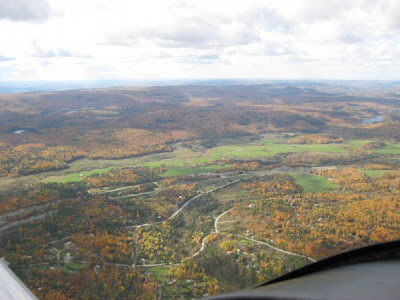

[a pic Dawn took from Andy's plane]


I woke up feeling an enormous sense of peace. I did not at first remember the plane-crash dream. But I did remember my two friends offering me their respective gifts. That’s when the phone rang.


Three weeks ago, I was still living in the furnished loft in Toronto I had rented after my apartment burned down in Montreal two years before. The thought of replacing all my things after the fire overwhelmed me (I did not have insurance), so I decided to live amongst someone else’s for a while. The bed was in a mezzanine, which meant I could not get down the ladder in time to answer the phone. But when I did get to the phone, I saw it was Dawn. Then it rang again. There had been a time when Dawn and I would talk to each other in the wee hours of the morning, both being early risers, but I was no longer on that schedule. Why was she calling so early?


“I have some bad news,” she said. My mind went blank.


“Andy died in a plane crash yesterday.”


I did not believe her. “No, no, no, no . . .” I repeated like an actor in a melodrama. I was watching myself react, rising above my body, hearing myself say lines.


Since that day, everything I could have said about my life is no longer sayable because it’s no longer true. My brother’s death has rearranged my reality, not to mention my very soul. On the eve of starting my life over in a new townhouse post fire, I did not do that. Instead, I stepped into an alternate reality that included staying with Dawn and the boys for an indeterminate amount of time in the house Andy built.


In the first week after Andy’s death, the funeral arrangements took over. The atmosphere was like a political candidate’s campaign office on the eve of an election. There was an air of excitement as we made grand plans for how to honour Andy. We did nothing by the book. Andy was a maverick his whole life, always pursuing and fulfilling every dream he ever had, each one centred on one life-affirming goal: to have an adventure.


Andy wanted to ride a motorcycle by the age of twelve. He asked my parents for money to pay for a broken-down bike he found. My father said no, imagining Andy zipping through the lawless streets of Manila. My mother said yes, arguing that the experience of fixing it up would be good for him, and assuming it would never be road worthy. But Andy not only restored it to purring order, he brought it up to showroom finish, chroming the fenders to a blinding polish. And, yes, he also drove it.


Ever since I’ve known him, if Andy wanted it, he either made money to buy it or he made money to build it. At 22, he began building his contracting business, starting with decks, and moving to kitchens, bathrooms, and basements. At 25, he built his first house. And somewhere between those two projects, Andy bought a new motorcycle and drove it across Canada in 11 days. At 38, he built his second house, a stunning showpiece. As his contracting business became successful and Andy could relax more, he grew restless, jonsing for a new adventure. This time, it was flying. First he got his pilot’s license, but within a year or two that was not enough. So he built his own plane. What takes most people five to ten years to build, Andy completed in 22 months. His plane passed every test with flying colours and Andy ensured it remained in perfect working order, obsessing over its maintenance before and after each and every flight. His meticulous care in building it, and his calm and qualified way of piloting it, earned him a reputation with the Experimental Aircraft Association as the go-to guy for building and flying advice. How do you memorialize someone like that?


You hold a service in an airplane hangar filled with classic planes (and cars).


Over 400 people attended. Over half of them weepy customers who liked him so much they had become his friends. Andy could make friends with anyone. But the mystery of his life is that he didn’t need them. Andy moved through the world on his own automated walkway, waving and smiling at us as he passed us by, but always speeding ahead.


At the end of the service on one of the coldest days of the year, Andy’s three flying buddies performed the “missing-man fly over" where a number of planes fly in formation until a single plane banks away from the rest and disappears into the horizon. A few days later, Andy’s youngest son said, “I think dad is still flying up there.”


That first week was filled with people, laughter and hope. But as everyone began to return to their respective homes, near and far, I slipped into a sadness I knew was just the tip of the iceberg. While Dawn felt Andy’s energy all around her and worked hard to be strong and make him proud, I felt every shred of my secular spirituality slip away. In my personal work to overcome previous heartbreaks and pains, I had developed a strong belief in a universe that would meet me half way if I focused on manifesting my dreams. Miracles have occurred in my life, or at least, I have chosen to see certain events that way, but that universe no longer seemed available to me. The question that crushed me the most was, “what if Andy is not an energy? What if after death there is simply nothing?”


I am a secular Jew. I do not believe in heaven or hell. And my Judaism amounts to angling for Passover-dinner invitations. But I did very much want to believe in the possibility of other dimensions, of the universes quantum physicists suggest might exist in tandem with our own, just on a different space-and-time continuum. I wanted a sign. I wanted proof. I wanted to believe. But I couldn’t, which meant Andy was simply gone, as if he had never been. Every day I woke up feeling sick.


Meanwhile, Andy had left behind a sole-proprietor contracting business that Dawn now had to do something with, a business about which she knew nothing. That’s when the miracles started to happen. Before Dawn’s brother-in-law returned with Dawn’s sister and their kids to Iowa after the funeral, he dug into Andy’s files and found out which jobs were outstanding, how much Andy’s customers owed him and how much Andy owed his suppliers. Within two days, Dawn’s brother-in-law had called all of Andy’s customers, assured them their jobs would be completed, and collected interim cheques. He also organized Andy’s employees, including past employees, to help finish the jobs, as well as created a list of suppliers for us to call for account cancellations. Finally, he created a schedule for Dawn to follow so that she could manage the business until everything was done. The most miraculous part: Dawn’s brother-in-law’s name is Thor.


Andy’s best friend’s wife is an accountant, which is exactly what Dawn needed when Andy died. She swooped in to help Dawn sort out all the financials while Andy’s best friend did everything else – from officiating at the funeral, to shovelling the walkway. When one of Andy’s employees became a problem (an employee so abusive we all begged Andy to fire him months earlier, but Andy didn’t because he was loyal to a fault), Dawn’s best friend’s husband’s brother, a former labour lawyer, put Dawn in touch with the best labour laywer in the province. Turns out, this labour lawyer’s husband shared Andy’s airplane hangar. She took the case and slashed her fees.


And those are just the big miracles. The small, sustaining miracles have included Andy’s flying friends taking over the sale of Andy’s portion of the hangar and pursuing the plane insurance, while the community came together to ensure that food never stopped coming, enabling Dawn to focus on her boys and getting the business settled so that she could move on with her own life.


By all rights, Dawn should be a puddle on the couch, one step away from being straight jacketed. Her mother died in a car crash when she was 12, her first boyfriend got macheted to death in Somalia when an angry mob turned on a small group of journalists (Dan Eldon was a young photojournalist of exceptional talent; his family published the most breathtaking book of Dan’s work after he died at 22). Dawn should not have had to endure another death of someone she loved. It’s just not fair.


But we don’t get to choose our destiny as much as we do get to choose it. And that’s the paradox I cannot seem to reconcile in my own belief system. Dawn worries that all the worrying she did about Andy dying while he was still alive may have contributed to his early death. That makes no sense to me. Dawn did not cause this. On the other hand, Dawn has equal belief in positive thoughts bringing about positive outcomes. I share that belief in so far as positive thinking usually leads to positive actions, which will surely up your odds for positive results.


But I also used to believe in something a little more than that. The Jungians call it synchronicity – when things come together in a way that simply cannot be chalked up to coincidence. For instance, there was this giant shipping trunk located in the front foyer of my apartment building in Montreal. It just sat there like a treasure chest pulled from a sunken ship. A few months after moving into the building, I was wishing I had more self help books. The next day, someone moving out put all kinds of things they didn’t need/want on the trunk. Amongst them, a pile of self help books. As a one-time event, it would have been easy to call it a coincidence. But it happened many times – things I needed just kept appearing: clothes, shoes, more books, etc., to the point where on my way out to the hardware store one day to replace a burnt-out light bulb, I saw one on the trunk. It was burnt out, too. But it was there.


Many “coincidences” have occurred in my life when I think about it. So why am I now doubting my former connection to things unseen-yet-recurring? Because I want a sign that Andy is somewhere among us so badly that I would rather assume the worst – that he isn’t – than suffer the blow of some scientist confirming that my worst fear is true: that death = nothingness. It’s like deciding the guy you like doesn’t like you before he has the chance to reject you, believing that rejecting him first will spare you the pain of that possible truth.


In an effort to find answers, I bought Elisabeth Kubler-Ross’s books on death and dying. Renown for her work with the dying, Kubler-Ross undertook a controversial, global study of peoples’ near-death experiences. It appears the experiences of those who have been pronounced clinically dead and then revived are consistent across age, race, culture, and religion. The person describes rising above his or her body and seeing everything that is going on – the doctors trying to save them on operating table, the accident scene, or whatever occurred when the person “died.” While briefly dead, the “deceased” sees previously deceased loved ones and describes the atmosphere of the “afterlife” as an all-encompassing sense of unconditional love. The skeptics call this experience wishful thinking. But Kubler-Ross counters them with the example of blind people who have been able to describe the jewelry, haircuts and other minute and specific details of the people around them at their “death.” Or children who claim to have seen deceased loved ones they never knew. How could they know that information?


I wanted so badly to believe. I pictured Andy floating above his crash site and then racing through time and space to visit each and every one of us. Did he bring me the plane-crash dream in order to prepare me for the call that would come a few hours later? Did he surround Dawn with his love so that she could find the strength wrap up his business while continuing to walk the earth as a woman still unconditionally loved? She certainly walks among us with an inner glow, despite the pain and anxiety of temporal things, such as life insurance money that has not yet arrived.


Andy was nothing if not pragmatic in all things. The idea of asking the universe to help manifest his dreams would have elicited a sardonic laugh. If he wanted something, he just did what was necessary to make it so. And he achieved his dreams quietly, on his own terms, asking for no one’s permission. He didn’t care what others did or thought. He simply stayed focused on what he wanted.


Three weeks after Andy’s death, I donated a portrait commission to help raise money for a children’s centre that burned down last year in Toronto and to raise awareness about me as a local portrait artist. Andy would have been the first person to say to me, “You can’t help me now. So go do your thing.” Instead, Dawn said it to me, as if channeling Andy. She sent me back to Toronto to attend the silent auction where my portrait commission was sold.


In my search for some kind of connection to Andy, I went to see a friend’s therapist (the wrong word for this woman, who trades in energy vs. neuroses.) I told her about my need for a sign. On the drive to her office, it occurred to me that Andy might have been sending signs, such as my dream, but that I just keep upping the ante for proof, not accepting what has been delivered to my disbelieving doorstep. After I told the therapist my plane-crash dream, she asked me, "Do you think that perhaps your brother is sending signs but you just keep not believing them?” And that is not the first time this kind of future déjà vu has occurred since Andy’s death. A few days after the funeral, I phoned my own therapist/guru back in Toronto, who encouraged me to encourage Dawn to talk to Andy and to send him love and let him know everything would be OK. I knew I would probably not share this little instruction with Dawn, thinking that such an intangible connection to Andy might only exacerbate her sense of loss. But a few days later when Dawn and I found a moment alone, she said to me, “Liz, I hope you don’t think I’m weird, but I talk to Andy all the time. Out loud. And I send him love so that he does not worry about me and boys.”


Dawn's continued connection to Andy has given me pause. Something is feeding this huge well of love Dawn has not only for Andy, but for her sons, and for herself. Watching her move through the world buoyed by all this love has been the key healing factor for me. I could not have survived losing Andy without Dawn in my life.


Last week, my father had a dream that seemed to come directly from Andy. In it, Andy was driving an Austin Mini (his plane was the aircraft equivalent to an Austin Mini) at breakneck speed on the border between a forest so dark you could barely distinguish the trees and a meadow as flat and manicured as a putting green. My father was in the back seat and Andy was at the wheel, laughing. My father begged him to slow down. He could see a woman in the distance standing at a podium dressed in a tailored black suit with a wide-brimmed black hat. Behind her was a man dressed in white robes with a long white scarf. The woman was delivering a funeral oration. Andy drove right for them, then right past them. He drove until there was no more forest or meadow, just emptiness. Before the dream ended, my father saw a line of text floating in space. It said, " If he made him...then he made all of us." My father said, “I knew in my mind that the phrase meant, if the gods made Andy...then Andy made us all.” That felt right. Not that the gods made us all, but that Andy made us. Andy was, indeed, the leader of our family. He blazed the trails and then came back to get us.


In comedy, timing is everything. In death, timing is also everything. Andy’s humour, for instance, came out of the blue, a sudden play on words when you least expected it, delivered in an understated way that would catch you off guard. His death happened in the same way. Out of the blue, catching us all off guard. In both cases, Andy was not trying to be the centre of attention. He was just doing his thing, toying with words or toys, testing them until something happened that even he did not expect, never satisfied with the world until it he had tried it out for himself.


Lately, I’ve been thinking about the role the English language plays in the life/death paradox. My brother died. That’s clear enough. Something happened in the past. But, “he was alive.” The verb speaks of a time that is past, yet the noun speaks of something that lives. And then there is, “He is dead.” The verb suggests continuity while the noun states finality. This paradox may be the reason I am having such a hard time knowing where/how/when Andy is. Is he? Is there an isness somewhere where Andy is, and if so, where, or, maybe more to the point, when?


But as my therapist/guru has been trying to show me for years, language is not the only paradigm for engaging with the world. As I watch my dog respond to the world spontaneously without the aid of language, I see that my therapist/guru might be right. Even neuroscientists have demonstrated that non-verbal activity, such as meditation, which often includes the act of observing thoughts without engaging them (insofar as that is possible), is not only an alternative way of understanding reality, it actually alters it. That's because meditation can actually create neural pathways where before there were none. Can we think ourselves into a new realities, material or otherwise? Or, rather, non-think ourselves into other worlds, other possibilities?


Tonight, as I was watching a rerun of “The River Runs Through It” on TV – a coming of age story (it doesn’t really matter what about) – it hit me. As we live, our lives unfold in unexpected ways. As we live, there is no end in sight. But when we die, we become a story with a beginning, middle and end. Andy already has. Macleans wrote about him in their last page devoted to interesting people who died. And we talk about him in ways we never did when he was alive, referring to him as a fully realized character with a predetermined story arc. Suddenly, his whole life seems to lead inexorably to building a plane and flying off into the sunset and/or tragically falling out of the sky. I ricochet between the two possibilities, praying for the former and fearing the latter. But it’s also possible both are true. Our lives are both unexpected and the stuff of stories.


I want to believe that Andy died doing what he loved. I want to believe his life ended because he was a highly evolved being who had more expansive horizons to explore which would require him to shed earth-bound things, including his own body. I want to believe our lives have a purpose and meaning because randomness is too hard on my psyche and soul. I want to pull threads together and see coincidences and miracles running through in a life lived that point to a greater purpose or fate or SOMETHING. But mostly, I want Andy to walk through the door and tell us that his death was staged so that he could collect the life insurance money. I want to take him for granted again, to know he’s a phone call away, to hear his voice on the other end asking matter-of-factly and with an open mind, as if anything at all were possible, “yes?”


With love,

Liz


Sunday, January 10, 2010

My Very Own Bee Hag


We all have one. And, no, it's not some naggy crone who goes clubbing with a hive of (gay) bees.

A bee hag, or, properly spelled, B-HAG, is your greatest dream, your Big Hairy Audacious Goal.


I first heard this term in a business meeting at which I was acting as imposter-cum-marketing expert. It was the year after I'd moved to Montreal to escape heartbreak and a painful graduate degree (which I'd done to escape heartbreak). Justin, my younger brother, called me up from Toronto to see if I wanted a marketing-writing gig, something for which I was not remotely trained. He needed to know RIGHT NOW, or else lose the client.

Montreal was where I was kinda sorta trying to start a portrait painting business, but in the end it "failed" because I spent too much energy on the business of being terrified, which made failure a guarantee. When you lie in bed most of the day dreaming up all the ways you will fail, it's kind of hard to convince others you are a painter, especially when you are not painting.


To pay my bills, I got myself hired at a flower store, one of the most backbreaking and unromantic jobs I've ever held. I lasted a month. And not because I quit, which I desperately wanted to do, but because Justin, the brother I'd tortured his entire childhood, saved me from death-by-roses. He asked me if I knew how to write marketing material. I said no. He said, "you're hired." His only requirement was that I promise never to show fear or lack of experience in front of clients. In exchange, he promised to mentor me. We both kept our promises. I got training that has led to better and better jobs, and he got to tell his clients something closer to the truth -- that his roster of employees included a marketing writer.


At the first meeting with Justin's clients, he kicked things off by asking the group of expensively suited men (with me in a miracle of a "business" ensemble I managed to pull together from nothing but wishful thinking) to define their organizational B-HAG. I was gobsmacked. Justin was not asking about their processes, programs or organizational structures. He was asking the senior leaders to express their most audacious dreams. In other words, he was speaking my language, the language of making meaningful choices in life (which I'd been reading about in life-coaching books to help me get out of bed), which meant I could not believe he was speaking theirs (I had so little faith in the corporate world back then.). When the CEO said he hoped they would grow the organization by five million a year, Justin patiently explained to him that, "that's not a B-HAG. You should expect that kind of growth. A B-HAG is fifty million growth in five years." You could almost hear Dr. Evil crowing, "one BILLION dollars!"


This statement would be an eye roller if Justin didn't have examples to back it up, which he did. Board-rooms full: companies that had set their goals high and then met them. How? Well, by taking steps towards those goals. It seems that if you set your sights on a small dream, then you'll only take steps small enough to achieve something small. If you set your goals on a great dream, then you'll take different steps to make the bigger dream happen. In other words, all dreams require steps, but you'll never arrive if you have no idea where you're headed. So, big or small, clarity of the destination is vital. But while you're dreaming, why not dream big? And, bonus, your journey towards a bigger goal will more than likely get you to your smallest goal along the way!


When I turned 40, I told myself (and my blog peeps) that I'd be living by a new motto: "there's no giving up." I had long since passed the age at which I could be considered a child prodigy, which meant I was free to do what I wanted, how I wanted, when I wanted. Not that anyone had held me back before, except me, but it helped to have the motto anyway. It meant I would at least try the things I had previously feared trying. Failure was not an option because failure was not an excuse (besides, define failure, please.) If failure was not an option, then giving up was also not an option.

My first order of business was to paint again. Which I did. During a month of freelance dead time, my head exploded with ideas that I tried to get down in paint. If there had been a soundtrack to my frenzy of activity, it would have been a maniacal laugh.

But before the month was out, I gave up.

I loathed my paintings. And that's putting it diplomatically. Yet something had changed. Yes, I wanted them burned in every ring of hell; but . . . I had not taken to my bed. And that's because I knew it didn't matter what I thought, or how bad the paintings were (or weren't).


A life-time pattern of giving up may be hard to give up, but I realized I didn't have to do it all at once. I could give up giving up in baby steps. So, I turned the paintings to the wall and told myself it was good that I painted at all. A year later, I painted again. A really good portrait of my friend's kid.


And then I painted again this year. Another really good portrait of another friend's kid, if I do say so myself.

So, perhaps it's more accurate to say I was givey uppy, which is different from actually giving up, which puts a period at the end of something. My giving up was more of an ellipses . . .

At 41-going-on-42, I've decided that forming a strategic alliance with a motto is effective, but it's no longer enough for me. I need to grow the Liz company. So, I've decided to adopt a B-HAG. Never one to do the easy or simple thing, as my therapist/guru never fails to point out, my B-HAG is similarly not simple or easy. It's more like an idea only a mother could support, like wanting become a chef at the Chef Boyardee factory. My B-HAG is a Medusa's head of writhing and slippery dreams that I intend to see as beautiful, and to let live.

One of those dreams is to have some kind of correspondence or meeting with Elizabeth Gilbert, author of Eat, Pray, Love. (see item #3 on my last post). Maybe even interview her for my blog.

The truth is, I don't have a clear plan. But, I am not waiting until I do. Which will make it hard to convince her publishers to pass along my request for face time, or even e-mail time. If I'd thought of this last year, I would have worked it into a series of thematic blog posts a la Julia Powel's (whose blog eventually led to her meeting Julia Child, her idol). I'm just not that organized or focused. The idea of talking to Liz is one of many things I want to do this year, but it hit me just after I bought my ticket to hear her talk with Heather Reisman at the end of February that I might make item #3 a reality since she'll be in Toronto. There's no harm in trying. I have to at least try!

But I can tell you why I want to meet her, even if I have no clue what I'm going to say to her, or ask her. I want to meet her because I think she's brave. She wanted to write and she did. She wanted to travel and she did. And she wanted to leave her marriage and she did. And none of it was easy; all of it took time and effort, and much of it caused her enormous pain, but she did it anyway. Simply put, she inspires me. She also makes me laugh.


But even those are not my reasons.

A few weeks ago, I sat in the living room of two of my favourite people, Mark and Tonya, and my new favourite inspiration, our mutual friend, Hilary, and I asked them to brainstorm with me about what I should do next. Thanks to a small inheritance, I was recently able to afford a down payment on a modest townhouse (which put a stop to my moving-to-Berlin-or-Sydney fantasies; at least for the time being). My contract job ends the month after I take possession, which means I need to find more work to pay my new bills. As a freelancer, I used to fear these kinds of transitions, but now I see them as opportunities.

A few things came from that conversation with my advisory board of three. One was to paint portraits (as a sideline), i.e. to try that as a business again (while still writing to earn my keep). The reason it could have failed in Montreal is that I didn't know anyone there. In Toronto, I am Malcolm Galdwell's "connector" made manifest. But what really hit home in the conversation was Tonya's take on my rightful vocation:

"I've always though you should have your own interview show."


She's not the only person who has said that to me. And it's kind of true. I am the person who can talk to anyone anywhere, be it a police line up, ordering take out in city where no one speaks English, or at a funeral of the great aunt of a friend of a friend. I am good at putting people at their ease, asking questions about them and their life and sharing stories. And I don't do it for prurient curiosity, or other reasons of exploitation. None of it gets reported in a public way (well, except sometimes they do appear in my blog but dressed up to ensure anonymity). I ask because I want to know, because here is a human being just like me and I am interested in their life story and how they feel about it. That's it. I like a story for its own sake.

At 41-going-on-42, however, and with no training in television/radio interviewing skills, never mind no job history or connections, and no real background in pop culture or celebrity schmoozing (I don't give a toss about celebrities, is the truth) . . .


. . . I can't really see how to make Tonya's B-HAG for me a reality.

Except . . . what if Liz G lets me interview her . . .

The reason Eat, Pray, Love was such an inspiration to me is because Liz wrote from the hip, and because she wrote in a way that said it's enough to be alive and loving, that you don't need a PhD to be lovable, listened to, or valuable. You can be a travel writer even if all you write about is the pasta you ate that day in Rome, and not about the history of the buttresses in this or that Cathedral. Buttresses bore me, let's be honest, and Liz made that OK. But descriptions of pizza made from dough as soft as kitten leather will get my attention every time.

I'd like to talk to Liz. I don't want to plug her new book, Committed, (although if she wants to, I have no issue with that), I don't want to probe her personal life anymore than she wants to divulge. I just want to have a conversation with her. Just because. Maybe we can talk about . . . me!


Here are my two final reasons for wanting to take on this B-HAG.

First, this snippet from her website:

I have a friend who’s an Italian filmmaker of great artistic sensibility. After years of struggling to get his films made, he sent an anguished letter to his hero, the brilliant (and perhaps half-insane) German filmmaker Werner Herzog. My friend complained about how difficult it is these days to be an independent filmmaker, how hard it is to find government arts grants, how the audiences have all been ruined by Hollywood and how the world has lost its taste…etc, etc. Herzog wrote back a personal letter to my friend that essentially ran along these lines: “Quit your complaining. It’s not the world’s fault that you wanted to be an artist. It’s not the world’s job to enjoy the films you make, and it’s certainly not the world’s obligation to pay for your dreams. Nobody wants to hear it. Steal a camera if you have to, but stop whining and get back to work.” I repeat those words back to myself whenever I start to feel resentful, entitled, competitive or unappreciated with regard to my writing: “It’s not the world’s fault that you want to be an artist…now get back to work.” Always, at the end of the day, the important thing is only and always that: Get back to work. This is a path for the courageous and the faithful. You must find another reason to work, other than the desire for success or recognition. It must come from another place.

And, the second, this thought about late bloomers:

Here’s another thing to consider. If you always wanted to write, and now you are A Certain Age, and you never got around to it, and you think it’s too late…do please think again. I watched Julia Glass win the National Book Award for her first novel, “The Three Junes”, which she began writing in her late 30’s. I listened to her give her moving acceptance speech, in which she told how she used to lie awake at night, tormented as she worked on her book, asking herself, “Who do you think you are, trying to write a first novel at your age?” But she wrote it. And as she held up her National Book Award, she said, “This is for all the late-bloomers in the world.” Writing is not like dancing or modeling; it’s not something where – if you missed it by age 19 – you’re finished. It’s never too late. Your writing will only get better as you get older and wiser. If you write something beautiful and important, and the right person somehow discovers it, they will clear room for you on the bookshelves of the world – at any age. At least try.

If "late thirties" is late blooming, then I have practically wilted and died on the vine at almost 42. Yet, there is always a story to trump my own for not starting something new (and scary). A friend of mine is making a documentary film about a man who was illiterate most of his life. When his wife died (she'd done all the reading for the both of them), he decided it was time for him to learn how to read. He was 94. Now he's about 103 and has become a spokesperson for literacy. Talk about an on-death's-doorstep bloomer. Good for him! But I don't want to wait that long.

Here's another story, one that Liz tells in Eat, Pray, Love, about a man who prays every day to a god statue in a fountain in Rome (can't remember which god or which fountain). He prays to win the lottery. After months (or it could have been years, I don't remember) of hearing this man's prayer, the god finally loses patience and yells at the man, "OK, OK, I will help you win the lottery, but for god's sake, you need to buy a ticket!"

Today, I write Lizzy G's publisher. And to ensure I don't leave this all to chance, I want to ask all of you to sign a petition in your heads that will help me plead my case to the Universe. It's a little bit of magic Liz used in her own life to get something she really, really needed. It worked for her. As I take my first step, I am just going to assume it will work for me, too . . .